I don't know what the deal is with everyone else who's making bread right now - a need to feel productive, maybe; extra time at home (though that makes less sense with dutch oven-style no-knead bread, which basically seems to just want you to put it in a bowl and leave it alone for hours, then chuck it in the oven). Bread might always have been a part of their lives and now they're baking it even more. For those who are single and without kids, it feels a little like a desperate attempt to show that one is doing something meaningful, but that might just be projection on my part. Maybe people just miss bread. I miss bread.
For me, it's a little of all of those, and also this: I used to be so good at making bread! It's true: in high school, in the interstitial summers between college semesters, and even in Seattle when I worked at the bookstore, I loved to bake bread. I made my grandmother's recipes: her dilly bread (no-knead, before it was cool), her challah. I made so much bread that it went stale before my three roommates and I could finish it.
Tuesday, April 14, 2020

Wednesday, August 16, 2017
actual literal nazis with actual literal semi-automatics
So there's all these memes, right now, with Uncle Sam punching Nazis or Wonder Woman punching Nazis or Captain America or whatever. This one -- I'll call it the "You again?" meme -- is the one that keeps sticking with me:


People I like have posted it. Websites I like have posted it. I appreciate those people and those websites, the optimism they display, the unity they endorse, the way they brand neo-Nazis as traitors. But every time I see an anti-Nazi meme, I feel an emptiness in my chest cavity, a twist in my gut, and this one in particular sets me off.
Let's start with a close reading. Uncle Sam -- significantly more muscular in this incarnation than he is usually portrayed, a brawler for sure -- takes up the majority of the frame, occupying most of the left hand side of the space. He is rolling up his right sleeve with his left hand, and holds a wrench in his left hand. He looks down on five men, all tiny in comparison: two are in Nazi uniforms and carry a Nazi flag, and three are in KKK uniforms and carry a confederate flag. The two men in Nazi uniforms look alarmed, terrified; their bodies are in defensive positions against the comparatively massive Uncle Sam. It's difficult to tell what the men (or women!) in the KKK uniforms are feeling because, you know, hoods.
Then the text. In large, retro font: "STOP the 'ALT-RIGHT'". And below, surrounded by stars: "We beat 'em before / we'll beat 'em now."
Well.
Let's be clear: despite the fact that there are actual literal Nazis in our country that are currently walking around with actual literal semi-automatics, there's not much comparison between our role in World War II and our role today. We're not America in this situation, swooping in to save others from hate while ignoring the hatred in our own land. We're Germany, and that hatred we've incubated for so long under the tautology of "this isn't who we are and therefore it can't be who we are" is burgeoning, bubbling, formless and engulfing us beyond our comprehension. This hatred is not the hatred of Nazi Germany, no matter how much some of its adherents might identify with Hitler's tenets. This hatred is home grown. It is ours. We've beaten it back before, but we've never beaten it. Not completely.
I lost my hope in the possibility of gun control after Newtown. I lost my hope in the possibility of police accountability after Philando Castile. I cannot tell my students that, and I don't know what I can tell them except what I always do: that I love them, that I believe them to be valuable, and that systems grow and change. I know the first two are true, and I try to know the last. I try so hard.
And I'm so pleased that Republicans have come out against Nazis, but wait, no I'm not because that is a ridiculous clause that I just wrote. Of course Republicans have come out against Nazis. That is a normal response. Nazis are easy enemies, because we already fought them in a war that is widely considered to be one of the most justifiable wars on record. Coming out against Nazis means -- should mean -- absolutely nothing.
Because as has been pointed out by people much more eloquent than I, focusing on those individuals and groups obsessed with retro Nazism distracts us from that obsession's interlinked sources: our home grown hatred of the Other and the white supremacy that is woven through the fabric of our systems and our daily lives.
Both of those sources lurk even within our anti-Nazi memes. The drawing from the "You again?" meme isn't original to that meme. It comes from a World War II propaganda poster.

So no, you don't get to say that we beat 'em before and we'll beat 'em again. Even then, even during World War II, we were them. Not as extremely, of course: our internment camps weren't death camps, and we weren't trying to take over the world. Let's also remember, though, that neither we nor any other country joined World War II because of the Holocaust, and that we have rarely intervened in genocides since the Holocaust.
We were not morally superior in a previous age. We are not morally superior now. The internet has given us an equality of voice, that's all, and white people can now hear of experiences they don't want to believe, because of our comforting tautology: "this is not who we are so this is not who we are."
And there's the alt-right, trying to make actual literal Nazis with actual literal semi-automatics normal, so that casual and already-normalized racism and sexism and homophobia and transphobia seep even deeper into the fabric of our lives, fading into the air that we breathe, and there are we, blithely ignorant, choking on air full of invisible, inevitable hate.
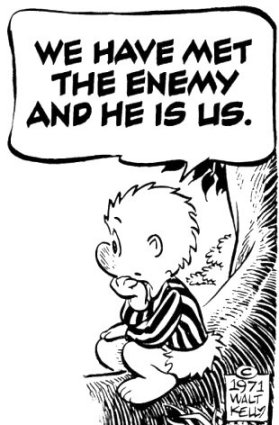
And thus, as Walt Kelly said, as always, as forever, as evergreen and never forget:
Sunday, February 26, 2017
What I'm Reading Because I Can't Focus On Anything And I Have No Words Left In Me
I am having trouble reading right now, especially fiction. I'm also having trouble watching TV, or movies, or anything except for a neverending youtube hole including videos of late night shows, Golden Globe speeches from Amy Poehler and Tina Fey, and, oddly, Brooklyn Nine-Nine, which makes no sense because it's basically a fantasyland about what the police should be in a dream world, except also the representation of women and people of color and LGBTQ is really good and I might understand why people find Andy Samberg attractive now, okay, FINE.
I've tried to read smart things and failed. I've tried to read stupid things and failed. Mostly I've just resigned myself to staring at the ceiling and planning my lessons and playing with the cat.
For some reason, though, the following texts have been possible:
• The internet, voraciously, unstoppably, as I try to learn as much as I can.
• The Handmaid's Tale.
• And some excerpts, some of my koans, that I read and listen to over and over again, that help me blink and stretch and breathe and move.
They're here for you, if you want them. I've provided a link for everything that has a link.
And please, give me more to read.
I. Learning
From a note ruminating on the post-election message to "just keep fighting," by Andrew Ti at Yo, Is This Racist?:
From "Now is the Time to Talk About What We Are Actually Talking About," by Chimamanda Ngozi Adichie:
From The Handmaid's Tale, by Margaret Atwood:
From "Home", by Warsan Shire
II. Inevitability
From Animal Farm, by George Orwell
From "Far From Narnia," a profile on Philip Pullman by Laura Miller in the New Yorker:
III. Life
I've tried to read smart things and failed. I've tried to read stupid things and failed. Mostly I've just resigned myself to staring at the ceiling and planning my lessons and playing with the cat.
For some reason, though, the following texts have been possible:
• The internet, voraciously, unstoppably, as I try to learn as much as I can.
• The Handmaid's Tale.
• And some excerpts, some of my koans, that I read and listen to over and over again, that help me blink and stretch and breathe and move.
They're here for you, if you want them. I've provided a link for everything that has a link.
And please, give me more to read.
I. Learning
From a note ruminating on the post-election message to "just keep fighting," by Andrew Ti at Yo, Is This Racist?:
If you’re lucky enough to have the time, energy and resources to “keep fighting,” you have to do that. You have to help take care of everyone who is going to lose something to the racism, sexism, homophobia, ableism and more that’s going to be empowered by the law and culture of the land.
But also, you have to listen to the people who, right now, are tired of bullshit phrases like that.
Because the people who are actually going to be hurt by Trump have always been fighting. They’re always fighting, every single minute of every single day. They don’t actually have a choice, and it’s condescending to imply that they’re doing anything but battle, with their every action (sometimes simply by existing), especially at their most weary.
From "Now is the Time to Talk About What We Are Actually Talking About," by Chimamanda Ngozi Adichie:
Now is the time to put the idea of the “liberal bubble” to rest. The reality of American tribalism is that different groups all live in bubbles. Now is the time to acknowledge the ways in which Democrats have condescended to the white working class—and to acknowledge that Trump condescends to it by selling it fantasies. Now is the time to remember that there are working-class Americans who are not white and who have suffered the same deprivations and are equally worthy of news profiles. Now is the time to remember that “women” does not equal white women. “Women” must mean all women.
From The Handmaid's Tale, by Margaret Atwood:
In this connection a few comments upon the crack female control agency known as the "Aunts" is perhaps in order. Judd -- according to the Limpkin material -- was of the opinion from the outset that the best and most cost-effective way to control women for reproductive and other purposes was through women themselves (308).
From "Home", by Warsan Shire
no one chooses refugee camps
or strip searches where your
body is left aching
or prison,
because prison is safer
than a city of fire
and one prison guard
in the night
is better than a truckload
of men who look like your father
no one could take it
no one could stomach it
no one skin would be tough enough
II. Inevitability
From Animal Farm, by George Orwell
Twelve voices were shouting in anger, and they were all alike. No question, now, what had happened to the faces of the pigs. The creatures outside looked from pig to man, and from man to pig, and from pig to man again; but already it was impossible to say which was which (Chapter 10, Paragraph 35).
From "Far From Narnia," a profile on Philip Pullman by Laura Miller in the New Yorker:
In his speech, Pullman contended that the literary School of Morals is inherently ambiguous, dynamic, and democratic: a "conversation." Opposed to this ideal is "theocracy," which he defined as encompassing everything from Khomeini's Iran to explicitly atheistic states such as Stalin's Soviet Union. He listed some characteristics of such states -- among them, "a scripture whose word is inerrant," a priesthood whose authority "tends to concentrate in the hands of elderly men," and "a secret police force with the powers of an Inquisition." Theocracies, he said, demonstrate "the tendency of human beings to gather power to themselves in the name of something that may not be questioned.
This impulse toward theocracy, he announced at the end of his speech, will defeat the School of Morals in the end." He sounded oddly cheerful making this prediction; in his books, Pullman enjoys striking a tone of melancholy resolve. He continued, "But that doesn't mean we should give up and surrender....I think we should act as if. I think we should read books, and tell children stories, and take them to the theatre, and learn poems, and play music, as if it would make a difference....We should act as if the universe were listening to us and responding. We should act as if life were going to win....That's what I think they do, in the School of Morals."
And as I sat there brooding on the old, unknown world, I thought of Gatsby's wonder when he first picked out the green light at the end of Daisy's dock. He had come a long way to this blue lawn and his dream must have seemed so close he could hardly fail to grasp it. He did not know that it was already behind him, somewhere back in that vast obscurity beyond the city, where the dark fields of the republic rolled on under the night.
Gatsby believed in the green light, the orgiastic future that year by year recedes before us. It eluded us then, but that's no matter -- tomorrow we will run faster, stretch out our arms farther.... And one fine morning -- --
So we beat on, boats against the current, borne back ceaselessly into the past (193).
Down, down, down into the darkness of the grave
Gently they go, the beautiful, the tender, the kind;
Quietly they go, the intelligent, the witty, the brave.
I know. But I do not approve. And I am not resigned.
III. Life
From The Once and Future King, by T.H. White:
From Nina Simone:
"You have a glass of this canary," said Sir Ector, "and go and see if old Merlyn can't cheer you up."
"Sir Ector has given me a glass of canary," said the Wart, "and sent me to see if you can't cheer me up."
"Sir Ector," said Merlyn, "is a wise man." "Well," said the Wart, "what about it?"
"The best thing for being sad," replied Merlyn, beginning to puff and blow, "is to learn something. That is the only thing that never fails. You may grow old and trembling in your anatomies, you may lie awake at night listening to the disorder of your veins, you may miss your only love, you may see the world about you devastated by evil lunatics, or know your honour trampled in the sewers of baser minds. There is only one thing for it then—to learn. Learn why the world wags and what wags it. That is the only thing which the mind can never exhaust, never alienate, never be tortured by, never fear or distrust, and never dream of regretting. Learning is the thing for you. Look at what a lot of things there are to learn—pure science, the only purity there is. You can learn astronomy in a lifetime, natural history in three, literature in six. And then, after you have exhausted a milliard lifetimes in biology and medicine and theocriticism and geography and history and economics—why, you can start to make a cartwheel out of the appropriate wood, or spend fifty years learning to begin to learn to beat your adversary at fencing. After that you can start again on mathematics, until it is time to learn to plough."
From Nina Simone:
Tuesday, February 7, 2017
To my students, then and now
To my students, then and now:
This was going to be an open letter to Betsy DeVos. I was going to tell her how important her new job is to this country, and that she holds your precious futures in her hand, and that she should listen to the teachers instead of plowing ahead, no holds barred, into the apocalypse. (That's all teachers want, right? Whether it's a group of senators or a gaggle of teenagers, we're just desperate for someone to listen.)
It was going to be a fiery letter, full of guts and glory and parallel structure, sprinkled with self-deprecating asides and heartfelt imagery. I would probably have raged while I was writing it, and wept, and raged some more. I've gotten very good at raging in the past few months.
I'm not going to write that letter.
It's not that the letter doesn't need to be written -- it does, and someone needs to tell Betsy DeVos that removing federal funding will absolutely devastate schools in states with no state income tax (like Washington) and that for-profit charter schools don't improve low-income education (like in Detroit) and that donating money to groups practicing anti-gay religious conversion therapy is absolutely fucking reprehensible. And, you know, proficiency and growth, and know your federal laws so that you don't swing us back into the dark ages of special education, and please god just listen to some teachers. That stuff.
But other people (lots of other people) are writing those letters, and the thing is, I don't really care about her, as a person? Like, at all? And I don't think she's going to listen to me. There's no point in my writing that letter -- there's no purpose. She's confirmed. It's done.
I'm writing to you now.
I'm writing to you, first and foremost, because I love you. You know that, I hope, because I'm careful to say it, because I mean it, because you're the lights of my life. It doesn't end when you graduate, either. It doesn't end when your political views differ from mine. It doesn't end when you've graduated from college, and now you're a grad student in linguistics in Columbus, Ohio, or when you're married (to each other? What is this even, I did not know that you were dating) and in the military and in Arizona, or when you dropped out of college and moved halfway across the world, or when one of you from China and one of you from Washington somehow ended up living in the same dorm in college, which just warms my heart to a ridiculous degree.
You're my kids, is what I'm saying, and you're never wriggling out of that one, so don't even try.
The second thing I want to say is something that I'm pretty sure you've all heard from me before, if you're my kid, if you were listening. It's this: the years when you're in high school are the years when you're most flung up against people who are wildly different from you. It's your chance to learn and listen, to perform that imaginative leap into the shoes of others, to discover that all people are complex human beings who are worthy of your respect and your tolerance, if not always your affection.
I really, really need you to remember that right now. Take a moment to feel every feeling you have in you. Think of one person -- your mother, perhaps, or your best friend, or your significant other. Feel every conflicting emotion that rises in you about that person. You love them so much it overwhelms you, but also you're a little embarrassed by them sometimes, but also you're proud of them, but also you kind of want to strangle them a little bit?
Now, as you hold all those conflicting, competing, complex emotions within you, realize: every other human in the world is as complicated. You are not alone.
Dizzying, right?
Students who are privileged in one way or another, let's take it one farther: your experience of the world is not the only one. If you are white, you have not experienced systemic racism or had your basic Americanness constantly under question. If you grew up wealthy, you do not have the experience of going to practice, then your after-school job and then tackling four hours of homework. If you are straight and cis, you don't have the experience of feeling casually-tossed "that's gay"s and "faggot"s cutting tiny slivers out of your self-worth. If you've always spoken fluent English, you don't have the experience of knowing that the words in your head don't match the building-block words that come out of your mouth, of knowing that people must see you as less intelligent than you know yourself to be.
You don't. You haven't lived it. So listen to those who do. They know what it's like -- at least, they know what it's like for them -- and you don't.
(I don't, either. I grew up as privileged as they come, and I still get things wrong all the time, and I listen, because how else will I learn?)
I love you all so much, and I'm asking you to show up for each other. Don't call each other A-rabs. Don't spit in each other's faces. Don't glance at each other shiftily, defensively, through the sides of your eyes. You have so much more in common than you hold in difference.
Because I can't write to Betsy DeVos, because she doesn't care about me and she doesn't care about you. Because the world is getting a lot harder, and it's unfair, and you all deserve so much fucking more than this, and I promise that I'm not done, you know that, right? I'm not done, I'm still going, and they'll have to pry my cold dead fingers away from my whiteboard before they get me out of my classroom, but my point is, you're in this now. You're in it. You.
And you -- you have so much more power than you know, over your own lives and the lives of each other. You only have that power, though, if you don't think of all the reasons for you not to trust "them," whoever "they" are.
Those reasons are useless and worthless nothings, meant to distract and destroy. Trust me, there is no "them." There's only all of you.
So: listen. And leap.
We need you.
Love,
Your teacher
This was going to be an open letter to Betsy DeVos. I was going to tell her how important her new job is to this country, and that she holds your precious futures in her hand, and that she should listen to the teachers instead of plowing ahead, no holds barred, into the apocalypse. (That's all teachers want, right? Whether it's a group of senators or a gaggle of teenagers, we're just desperate for someone to listen.)
It was going to be a fiery letter, full of guts and glory and parallel structure, sprinkled with self-deprecating asides and heartfelt imagery. I would probably have raged while I was writing it, and wept, and raged some more. I've gotten very good at raging in the past few months.
I'm not going to write that letter.
It's not that the letter doesn't need to be written -- it does, and someone needs to tell Betsy DeVos that removing federal funding will absolutely devastate schools in states with no state income tax (like Washington) and that for-profit charter schools don't improve low-income education (like in Detroit) and that donating money to groups practicing anti-gay religious conversion therapy is absolutely fucking reprehensible. And, you know, proficiency and growth, and know your federal laws so that you don't swing us back into the dark ages of special education, and please god just listen to some teachers. That stuff.
But other people (lots of other people) are writing those letters, and the thing is, I don't really care about her, as a person? Like, at all? And I don't think she's going to listen to me. There's no point in my writing that letter -- there's no purpose. She's confirmed. It's done.
I'm writing to you now.
I'm writing to you, first and foremost, because I love you. You know that, I hope, because I'm careful to say it, because I mean it, because you're the lights of my life. It doesn't end when you graduate, either. It doesn't end when your political views differ from mine. It doesn't end when you've graduated from college, and now you're a grad student in linguistics in Columbus, Ohio, or when you're married (to each other? What is this even, I did not know that you were dating) and in the military and in Arizona, or when you dropped out of college and moved halfway across the world, or when one of you from China and one of you from Washington somehow ended up living in the same dorm in college, which just warms my heart to a ridiculous degree.
You're my kids, is what I'm saying, and you're never wriggling out of that one, so don't even try.
The second thing I want to say is something that I'm pretty sure you've all heard from me before, if you're my kid, if you were listening. It's this: the years when you're in high school are the years when you're most flung up against people who are wildly different from you. It's your chance to learn and listen, to perform that imaginative leap into the shoes of others, to discover that all people are complex human beings who are worthy of your respect and your tolerance, if not always your affection.
I really, really need you to remember that right now. Take a moment to feel every feeling you have in you. Think of one person -- your mother, perhaps, or your best friend, or your significant other. Feel every conflicting emotion that rises in you about that person. You love them so much it overwhelms you, but also you're a little embarrassed by them sometimes, but also you're proud of them, but also you kind of want to strangle them a little bit?
Now, as you hold all those conflicting, competing, complex emotions within you, realize: every other human in the world is as complicated. You are not alone.
Dizzying, right?
Students who are privileged in one way or another, let's take it one farther: your experience of the world is not the only one. If you are white, you have not experienced systemic racism or had your basic Americanness constantly under question. If you grew up wealthy, you do not have the experience of going to practice, then your after-school job and then tackling four hours of homework. If you are straight and cis, you don't have the experience of feeling casually-tossed "that's gay"s and "faggot"s cutting tiny slivers out of your self-worth. If you've always spoken fluent English, you don't have the experience of knowing that the words in your head don't match the building-block words that come out of your mouth, of knowing that people must see you as less intelligent than you know yourself to be.
You don't. You haven't lived it. So listen to those who do. They know what it's like -- at least, they know what it's like for them -- and you don't.
(I don't, either. I grew up as privileged as they come, and I still get things wrong all the time, and I listen, because how else will I learn?)
I love you all so much, and I'm asking you to show up for each other. Don't call each other A-rabs. Don't spit in each other's faces. Don't glance at each other shiftily, defensively, through the sides of your eyes. You have so much more in common than you hold in difference.
Because I can't write to Betsy DeVos, because she doesn't care about me and she doesn't care about you. Because the world is getting a lot harder, and it's unfair, and you all deserve so much fucking more than this, and I promise that I'm not done, you know that, right? I'm not done, I'm still going, and they'll have to pry my cold dead fingers away from my whiteboard before they get me out of my classroom, but my point is, you're in this now. You're in it. You.
And you -- you have so much more power than you know, over your own lives and the lives of each other. You only have that power, though, if you don't think of all the reasons for you not to trust "them," whoever "they" are.
Those reasons are useless and worthless nothings, meant to distract and destroy. Trust me, there is no "them." There's only all of you.
So: listen. And leap.
We need you.
Love,
Your teacher
Sunday, November 13, 2016
What Could Happen
There are two big questions: What happened? And what will happen?
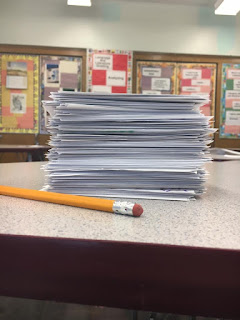 I don't have an answer to either, but maybe here's a start: on Thursday, I told my students that none of us, as yet, had any answers about this election. I made each class spend five minutes writing down every question they could think of on index cards. At the end of the day, I had a towering stack of cards, one that defied any attempt to contain its abundance: rubber bands, paper clips, and folders were all useless and I ended up putting the cards loose in my backpack.
About a third of the questions were repeats, wondering how Donald Trump was elected. Most of my students are from Brooklyn, have rarely left Brooklyn; they do not know a world where so many would vote for Trump. Their incredulity rings clear in their questions -- why? how? What will happen now?
Other questions, though, get deeper. My students are smart, perceptive, naive, funny and afraid. Some questions dig deeply into policy and politics; others reveal vast, cavernous fears. A sampling, presented without further comment:
 I don't have an answer to either, but maybe here's a start: on Thursday, I told my students that none of us, as yet, had any answers about this election. I made each class spend five minutes writing down every question they could think of on index cards. At the end of the day, I had a towering stack of cards, one that defied any attempt to contain its abundance: rubber bands, paper clips, and folders were all useless and I ended up putting the cards loose in my backpack.
About a third of the questions were repeats, wondering how Donald Trump was elected. Most of my students are from Brooklyn, have rarely left Brooklyn; they do not know a world where so many would vote for Trump. Their incredulity rings clear in their questions -- why? how? What will happen now?
Other questions, though, get deeper. My students are smart, perceptive, naive, funny and afraid. Some questions dig deeply into policy and politics; others reveal vast, cavernous fears. A sampling, presented without further comment:
Monday, October 10, 2016
Water, not rock
I've been trying to write this blog post for the last two weeks and I can't seem to start it right, so I guess I'm just going to keep typing. I hope you'll keep reading as I try to figure this out.
I have a challenging group of kids this year. I know this because everyone and their mom told me ahead of time that I would have a challenging group of kids this year. I also know this because last year, I saw these kids walk out of classrooms with impunity, throw each other across the hallway in play fights that became more than play, swear with creativity and without compunction at their teachers and each other, and, worst of all, put their heads down, on their desks, in their cell phones, casting themselves out of the school building and away from our reach.
I have a challenging group of kids this year. I know this because everyone and their mom told me ahead of time that I would have a challenging group of kids this year. I also know this because last year, I saw these kids walk out of classrooms with impunity, throw each other across the hallway in play fights that became more than play, swear with creativity and without compunction at their teachers and each other, and, worst of all, put their heads down, on their desks, in their cell phones, casting themselves out of the school building and away from our reach.
Sunday, May 1, 2016
Balanced, home
During the first day of summer break, the custodians opened every locker in the halls of Oberlin High School. The locker doors would stand open for a few hours while the custodians cleaned them out; they'd throw all the contents into a giant, industrial-sized trash can. OHS was small and quickly traversed -- if you looked at a floor plan of the hallways from above, it would look like a lollipop on a stick -- and an enterprising seven year-old could easily investigate each and every locker before the custodians finished, skimming out treasures: mechanical pencils with plenty of lead, a miniature stapler, an abandoned ugly clay ashtray from art class, a red knit hat. The school was empty, save the custodians, administrators, and a few teachers who were still finishing up their grades and cleaning their classrooms. The halls were ghostly-silent, and anyone who'd ever fought through their normally boisterous cacophony would find the whole thing eerie.
Wednesday, February 17, 2016
An Open Letter to First-Year Teachers
An Open Letter to First-Year Teachers (or student teachers,
or would-be teachers, or all teachers, or those concerned with the care and
maintenance of teachers):
Dear First-Year Teachers,
It’s February, and you may be starting to feel existentially
overwhelmed. I know I did, when I was in
your shoes. You did your student
teaching, you spent what seemed to be an interminable amount of time in courses
on theories of education, and now you’ve had your very own classes for about
five months. You may – and I might just
be projecting on this one – be feeling the weight of the system, in a way that
manifests as a combination of anxiety and a sinking, dread-filled pit in your
stomach.
Friday, January 29, 2016
Outside Jew
When people ask me where I live, I say "South Williamsburg." Then, inevitably, in an inept and snobbish attempt to distinguish my neighborhood from Fancy Williamsburg, I add: "Where the Jews live."
Then I get even more awkward, usually because of the startled look on my conversation partner's face. What follows is an increasingly ridiculous and offensive ramble:
"The Hasids!" I blurt. "I'm Jewish. Well, half Jewish. But I live in a super Hasidic neighborhood. They hate me because I'm the wrong kind of Jew. But not all Hasids feel like that -- just the Satmar, that's one of the sects, Hasidism has sects. I mean, sects, like sect. Not sex. Anyway, that's the sect that lives in my neighborhood. And maybe they don't even hate me, I mean, I just feel like they know that I'm Jewish and I have tattoos so that I can't be buried in Jewish cemetery, I guess? Anyway, those Jews. I guess I also live where other kinds of Jews live, because I'm Jewish, so wherever I live is where Jews live? But, um, anyway, HASIDS."
Then I get even more awkward, usually because of the startled look on my conversation partner's face. What follows is an increasingly ridiculous and offensive ramble:
"The Hasids!" I blurt. "I'm Jewish. Well, half Jewish. But I live in a super Hasidic neighborhood. They hate me because I'm the wrong kind of Jew. But not all Hasids feel like that -- just the Satmar, that's one of the sects, Hasidism has sects. I mean, sects, like sect. Not sex. Anyway, that's the sect that lives in my neighborhood. And maybe they don't even hate me, I mean, I just feel like they know that I'm Jewish and I have tattoos so that I can't be buried in Jewish cemetery, I guess? Anyway, those Jews. I guess I also live where other kinds of Jews live, because I'm Jewish, so wherever I live is where Jews live? But, um, anyway, HASIDS."
Friday, December 25, 2015
Luck
If you know me, you probably know that Christmas Eve is one of my favorite days of the year. No, there's no orgy of wrapping paper and gifts, no roast beast -- and no, I'm not even Christian. But I love tradition and I love family and I love anticipation, and on Christmas Eve I get all three: decorating the tree, finishing the advent calendar that my grandfather carved decades ago (a small bronze cast of Notre Dame rotates in and out of ultimate spot), helping my mother cook, watching the cats try to outsmart the Christmas tree, and most of all, listening to the King's College Choir's set of Lessons and Carols.
If my family feels holy about anything, it is architecture and music.
If my family feels holy about anything, it is architecture and music.
Wednesday, October 21, 2015
Afterschool
Today is the first time in two years that I've had an end-of-marking-period "afterschool," in which I stay after school (duh doi) with kids so that they can do work. Traditionally during these things, I tell the kids I can stay until the custodians set the alarm. In Federal Way, that was 10 p.m., though I never had a kid stay that late; I think the latest was around 8:30. Here, the alarm is set at 6 p.m., so I'm staying two days in a row to make up for it: today and tomorrow.
Because afterschool always comes near the end of the marking period, it coincides with me being ridiculously stressed out. I dread it a little bit the day before it happens. After all, here I am, trying to figure out kids' grades, drowning in paperwork, unsure what I'm teaching the next day, and totally unable to get work done while kids are actually in the room, so why am I taking valuable time away from my life? Don't I need this time for, you know, EVERYTHING?
(And it's not like I can use afterschool for doing any of this stuff. "Why don't you just grade while we're in here?" a girl once asked, to which I responded, "Do you actually want me to grade your work when I'm this distracted? Because I don't think you do.")
Because afterschool always comes near the end of the marking period, it coincides with me being ridiculously stressed out. I dread it a little bit the day before it happens. After all, here I am, trying to figure out kids' grades, drowning in paperwork, unsure what I'm teaching the next day, and totally unable to get work done while kids are actually in the room, so why am I taking valuable time away from my life? Don't I need this time for, you know, EVERYTHING?
(And it's not like I can use afterschool for doing any of this stuff. "Why don't you just grade while we're in here?" a girl once asked, to which I responded, "Do you actually want me to grade your work when I'm this distracted? Because I don't think you do.")
Friday, September 25, 2015
Kids These Days
"So," says the bartender/airport check-in lady/person waiting in line with you, as soon as they find out that you're a high school teacher: "What are they like? Kids these days?"
They always give an ironic little smirk when they're saying it -- as if to proclaim their awareness of the innate ridiculousness of the phrase, to insist that they're not like the fuddy-duddies who they imagine are the ones usually asking this question.
Still, it's barely a question. They already know their answer.
They always give an ironic little smirk when they're saying it -- as if to proclaim their awareness of the innate ridiculousness of the phrase, to insist that they're not like the fuddy-duddies who they imagine are the ones usually asking this question.
Still, it's barely a question. They already know their answer.
Monday, August 17, 2015
What I Wouldn't Write
I. Needles
A few months before I moved to Beijing, my parents -- who know me well -- bought me six or seven books on China. I eventually read my way through 4.12 of them (damn you, Oracle Bones!), but the one that immediately caught my attention was China in Ten Words, by Yu Hua. I read through it in about six hours, and was riveted by Yu's account of his country: by turns heartbreaking and hilarious, these essays/memoirs/ruminations on his own personal narrative and a wider Chinese history caught at me.
In one of the essays ("Reading"), Yu recounts how, as a child of the Cultural Revolution, he became a voracious reader (the story involves him asking random strangers on the street for books, hoarding tattered copies of French classics with missing identifying marks (like titles or authors), and his older brother punching a librarian in the face). In another, he describes the first time he saw an execution.
In a way, the most poignant of his stories comes from the introduction. Here, he tells us that when he was eighteen, his job was to go to factories and inoculate workers. His team would reuse the same needles again and again. One day, they inoculated children, and the children cried when the needles came out. When he examined the needles, he saw that they had become so barbed that they ripped out little pieces of skin when he withdrew them. He had never noticed before, because the workers had never complained.
A few months before I moved to Beijing, my parents -- who know me well -- bought me six or seven books on China. I eventually read my way through 4.12 of them (damn you, Oracle Bones!), but the one that immediately caught my attention was China in Ten Words, by Yu Hua. I read through it in about six hours, and was riveted by Yu's account of his country: by turns heartbreaking and hilarious, these essays/memoirs/ruminations on his own personal narrative and a wider Chinese history caught at me.
In one of the essays ("Reading"), Yu recounts how, as a child of the Cultural Revolution, he became a voracious reader (the story involves him asking random strangers on the street for books, hoarding tattered copies of French classics with missing identifying marks (like titles or authors), and his older brother punching a librarian in the face). In another, he describes the first time he saw an execution.
In a way, the most poignant of his stories comes from the introduction. Here, he tells us that when he was eighteen, his job was to go to factories and inoculate workers. His team would reuse the same needles again and again. One day, they inoculated children, and the children cried when the needles came out. When he examined the needles, he saw that they had become so barbed that they ripped out little pieces of skin when he withdrew them. He had never noticed before, because the workers had never complained.
Sunday, July 19, 2015
In Transition
In the eleventh grade year of Language & Literature at my Beijing school, we read an essay by David Sedaris entitled "Chicken Toenails, Anyone?" In this essay, Sedaris (fresh off a trip to Japan) goes to China and has some culture shock. Because he's Sedaris, he reacts to his culture shock with brutally funny observations; disappointingly, he uncharacteristically spends too little time reflecting on what his reactions to China might mean about him. The usual Sedaris self-deprecation is mostly absent, and he goes for low-hanging fruit: dirt, organ meat, and China's ever-present bodily fluids. He takes delight in comparing China's chaos to what he observes as Japan's careful aestheticism. As my students said, it's not that what he says about China isn't true, it's just that it isn't complete.
Sunday, June 28, 2015
Last Days
For those who don't know, these past few days have been my last in Beijing. I'll be moving back to New York City after a seven-year hiatus, which fills me with joy and trepidation and excitement and basically All The Feelings, which will have to wait for another blog post because this post is about Beijing.
I just reread my post from my first days here, and it's a little odd (but completely satisfying) how these last days have been their echo. It is mildly-to-grossly polluted, just as it was when I arrived. I went to Tiananmen Square on the way to the Forbidden City yesterday, and still managed to be bewildered by the place: surely I'd never gotten that close to the portrait of Mao before? Was the flagpole always that far away? (Answer: you came into the square from a different subway exit, Crawford, ya ding dong.)
Sunday, June 14, 2015
Divestment
Last night, I stayed in the Holiday Inn down the street from my apartment. Mine was the kind of hotel room that I dreamed of when I was little: a colorful little pod, it seemed to have sprung out of Tintin: Explorers on the Moon or some half-remembered Babar title. The shower wall curved in wavy fish glass against the neat white queen bed, a minimal-but-comfy green sofa was tucked into the corner by the window, and a bright blue space-conserving Murphy desk completed the picture. The whole effect was simple, clean, warm, and cozy: a nest.
Sunday, April 19, 2015
I, Procrastinator
Just to warn you, this essay is a little bit off the norm. I'm not talking about travel or place or my family or, um, anything respectable. Instead, I'm going to talk about a subject that makes me squirm with shame. I'm going to talk about procrastination -- and specifically, teachers who procrastinate -- and specifically, me.
Honestly, I wasn't even going to post this. I wrote the bones out as a sort of therapy-kickstarter-thing, and to put it on the internet seemed self-indulgent. But my friend Shari (a magical creature who is good at words and feelings and making me feel like a loved human being) seemed to think would be okay, so here it is.
(Does recognizing something as self-indulgent and doing it anyway make it less self-indulgent, or more?)
Honestly, I wasn't even going to post this. I wrote the bones out as a sort of therapy-kickstarter-thing, and to put it on the internet seemed self-indulgent. But my friend Shari (a magical creature who is good at words and feelings and making me feel like a loved human being) seemed to think would be okay, so here it is.
(Does recognizing something as self-indulgent and doing it anyway make it less self-indulgent, or more?)
Sunday, March 15, 2015
A Lack
A little more than a year ago, I posted about the South Korean ferry sinking. That tragedy immobilized me. I didn't cry, but I raged; I walked around with a sick, rotten feeling sunk deep in my stomach. I'd never lost a student before, and I couldn't fathom losing an entire junior class.
Now there's an empty chair in my classroom.
We all know why it's empty. The sixteen of us -- fifteen of us -- have been in this classroom since August of 2013, when we first came together for 11th Grade Language & Literature. I've loved this class dearly for the last year and a half, despite the bizarre gender ratio: thirteen boys and three girls.
Two girls.
Now there's an empty chair in my classroom.
We all know why it's empty. The sixteen of us -- fifteen of us -- have been in this classroom since August of 2013, when we first came together for 11th Grade Language & Literature. I've loved this class dearly for the last year and a half, despite the bizarre gender ratio: thirteen boys and three girls.
Two girls.
Tuesday, February 17, 2015
The Living and the Dead
With the usual apologizes to Dodie Smith: I write this sitting next to a saltwater pool in Cambodia. A waterfall patters into it from a balcony above. Surrounding the pool are a mixture of trees: palms, bougainvillea, bamboo. Some trees I can't identify, but they are by turns gnarled and youthful in appearance, with dusty dark and spiderweb-like fresh green leaves. Two large earthenware pots are full of water and lotus flowers. Enclosing the pool (beyond the trees) are the white-and-wooden walls of the boutique hotel we are staying in; with their orange roof tiles and dark wooden balconies, these buildings manage to exude an aura both cozy and sleek. Black and orangey-cream tiles line the floor of the bar to my left in a checkerboard pattern. A red Chinese lantern hangs from one of the taller trees, and in the pool, a medium-sized rubber yellow deer floats exhaustedly, happily, incongruously, on its side.
Today, I turned down what will probably be my only chance to see Angkor Wat. On what will probably be my last day ever in Siem Reap (my aunt and I take the boat to Phnom Penh tomorrow), I spent most of the day inside, asleep.
Let me explain.
Today, I turned down what will probably be my only chance to see Angkor Wat. On what will probably be my last day ever in Siem Reap (my aunt and I take the boat to Phnom Penh tomorrow), I spent most of the day inside, asleep.
Let me explain.
Saturday, December 13, 2014
Noise
With apologies to my favorite first sentence of all time: I write this sitting in the kitchen sink.
Okay, not quite. I write this sitting in the Beijing airport. I'm at Gate E31, preparing to board a 13+ hour flight back to the United States for Christmas. This place is all glass and chrome and marble: the wall to my right slants out like the main branch of the Seattle library, and if I look to my left I can see the little airport train scooting along through another massive wall of windows. There's a yellow charging station next to me, with strict instructions to "keep children away from the socket," but it doesn't work. I tried. If I didn't have headphones on right now, I'd be listening to the same three Christmas songs on repeat; as it is, I'm listening to a combination of Jessie J, New Orleans jazz standards played on the harpsichord, and the Mikado. I really hope my iPhone doesn't run out of batteries.
Okay, not quite. I write this sitting in the Beijing airport. I'm at Gate E31, preparing to board a 13+ hour flight back to the United States for Christmas. This place is all glass and chrome and marble: the wall to my right slants out like the main branch of the Seattle library, and if I look to my left I can see the little airport train scooting along through another massive wall of windows. There's a yellow charging station next to me, with strict instructions to "keep children away from the socket," but it doesn't work. I tried. If I didn't have headphones on right now, I'd be listening to the same three Christmas songs on repeat; as it is, I'm listening to a combination of Jessie J, New Orleans jazz standards played on the harpsichord, and the Mikado. I really hope my iPhone doesn't run out of batteries.
Subscribe to:
Posts (Atom)